








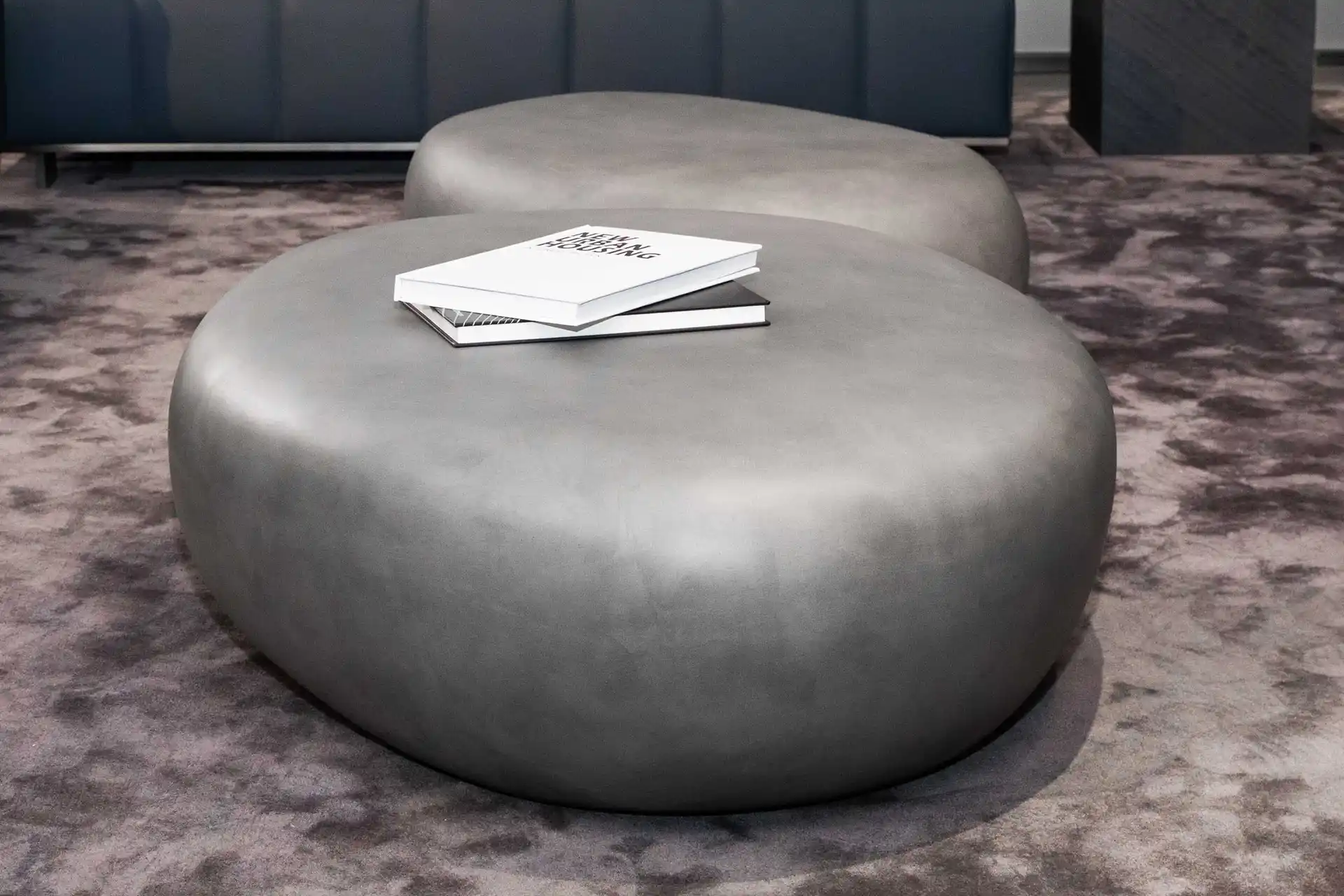
If you want to buy concrete furniture, you are choosing more than just a piece of furniture – it is an investment in durability, design and timeless elegance. In this guide, you will find out what makes concrete furniture special, what materials are behind it, where it can be used and why modern GF concrete(glass fiber reinforced concrete) technology takes it to a new level.
1 What exactly is concrete furniture?
Concrete furniture is made of either solid concrete or modern concrete composites. They are characterized by their striking structure, exceptional stability and clear design language. Typical examples include dining tables, coffee tables, side tables, benches and even shelves. These pieces of furniture make a stylish statement in any room and look like small architectural objects.
While many people associate Beton primarily with rough industrial charm, modern designs reveal a new, elegant side to this material. With smooth or discreetly textured surfaces, individual color tones and clear lines, concrete furniture not only fits in lofts or gardens, but also in classic living spaces.
1.1 Material variants at a glance
Not all “concrete furniture” has the same structure. In practice, there are three main material groups:
- GF concrete(glass fiber reinforced concrete): modern, reinforced concrete with high strength and low weight.
- Classic solid concrete: very heavy, extremely robust, more suitable for solid outdoor elements.
- Concrete-look solutions (MGO panels, decorative panels, foils, spatula technology): visually similar to Beton, but technically much lighter and less resilient.
| Material | Weight (relative) | Typical wall thickness | Area of application |
|---|---|---|---|
| GF concrete(glass fiber reinforced Beton) | approx. 30-40 % lighter than solid concrete | approx. 15-30 mm | Indoor & outdoor, designer furniture |
| Classic Beton | 100 % (reference) | approx. 40-80 mm | Fixed benches, walls, solid tables |
| Concrete look (MGO, decor, foil, filler) | Significantly lighter than solid concrete | Often only a few millimetres of coating | Predominantly indoor, decorative use |
2 Why is concrete furniture so popular?
2.1 Durability and robustness
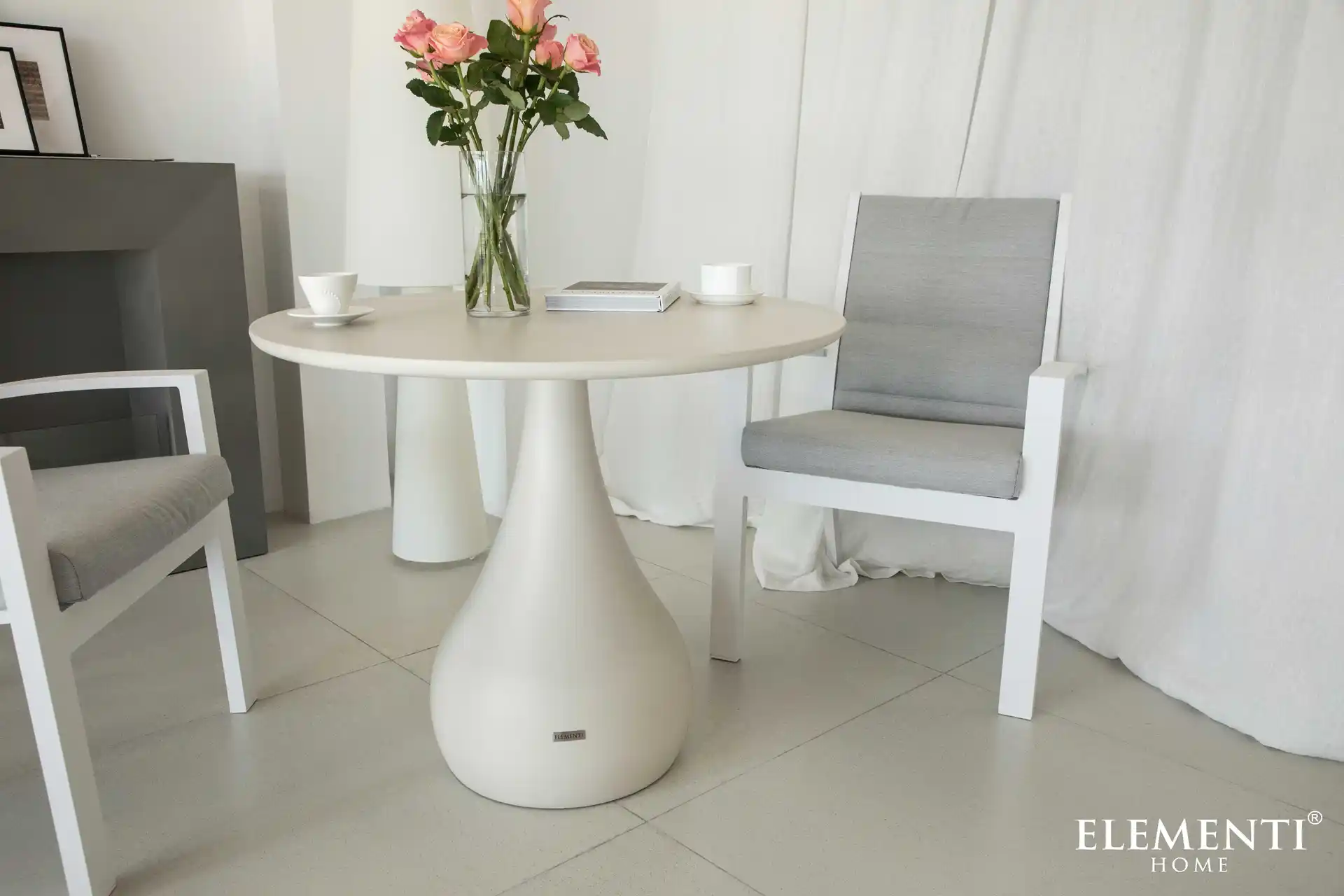
Beton is one of the most resistant materials in furniture construction. High-quality concrete furniture can easily withstand temperature fluctuations, UV radiation, moisture and mechanical stress. If you want to buy concrete furniture, you are choosing a product that – with the right care – can be used not just for a few years, but often for a decade.
Practical values show that well-sealed exterior concrete surfaces have a theoretical service life of well over 10 years without the basic structure being impaired. Small traces of use are often perceived as patina and emphasize the character of the material.
2.2 Timeless design
The neutral colour palette of grey and beige tones harmonizes with almost any furnishing style – from Scandinavian minimalist to rustic or Mediterranean. Concrete furniture has a calm, flat and clear effect without pushing itself to the fore.
Especially in combination with wood, textiles and metal, the result is an exciting mix of materials: Beton brings calm and stability, while wood and fabric provide warmth and coziness. This means that concrete furniture can be flexibly integrated without “ageing” visually or following a short-term trend.
2.3 Versatility in use
Whether in the living room, on the terrace or in public areas – concrete furniture can be used both indoors and outdoors. In cafés and hotels, they create a modern, professional ambience; in the garden, they are an eye-catcher with functional added value.
- Indoor: coffee tables, dining tables, sideboards, solitary furniture.
- Outdoor: garden tables, lounge tables, benches, storage areas next to fireplaces.
- Commercial: Reception areas, hotel lobbies, terraces in restaurants and hotels.
3 Challenges with traditional Beton
As impressive as the advantages are, there are also disadvantages: Classic solid concrete is very heavy and often difficult to transport. A large table made of solid concrete can quickly weigh several hundred kilograms – this makes delivery, assembly and subsequent redesign of the rooms more difficult.
Conventional Beton is also relatively rigid. High temperature fluctuations or improper processing can cause hairline cracks. These are often purely visual in nature, but many customers find them annoying.
This is precisely where the further development towards GF concrete comes in: the same or greater stability with significantly lower weight and controllable surface quality.
4 Our GF Beton innovation – the next generation of Beton furniture
We rely on GF concrete(glass fiber reinforced concrete), often referred to as GFRC (Glass Fiber Reinforced Concrete) in an international context. Compared to conventional Beton, glass fiber reinforcement can reduce the wall thickness without compromising the load-bearing capacity. In practice, this means
- Weight reduction of approx. 30-40 % compared to comparable solid concrete furniture.
- significantly higher bending tensile strength of the panels.
- more stable edges and less risk of breakage during transportation and daily use.
4.1 Advantages of GF Beton furniture in detail
- Weight advantage: Easier transportation, less strain on surfaces (e.g. roof terraces) and more flexibility when redesigning your rooms.
- High stability: Combination of compressive strength of the concrete matrix and tensile strength of the glass fibers – ideal for intensive everyday use.
- Weather resistance: When correctly sealed, GF beton furniture is ideal for outdoor use: Rain, sun and frost can do them little harm.
- Fine surfaces: Thinner layers and special shapes enable fine textures, softer edges and individual designs that would be difficult to achieve with solid concrete.
Further technical details, specific examples and a more in-depth explanation of the material properties can be found here:
👉 More about the advantages of Beton in the material knowledge guide
5 Typical areas of application for GF concrete furniture
5.1 Living area: coffee tables, living room tables, side tables
In interiors, GF concrete furniture is mainly used where design and suitability for everyday use need to come together: as a coffee table in the center of the seating area, as a side table next to the sofa or as a striking dining table. Thanks to the weight savings, this furniture is also easier to handle than solid Beton when moving or rearranging.
5.2 Outdoor: terraces, gardens and roof areas
GF concrete shows off its weather resistance on terraces and in gardens. Compared to wood, surfaces do not need to be constantly oiled and, unlike many plastics, there is no risk of brittle ageing due to UV light. On roof terraces, the lower weight is a functional advantage because static loads are limited.
5.3 Trade and hospitality
In hotels, restaurants or vacation properties, GF concrete furniture enables high-quality but robust furnishings. It has a prestigious appearance, is easy to clean and can withstand a high frequency of use – an important factor when tables are used daily by changing guests.
6 What you should look out for when buying
Before you buy concrete furniture, it is worth taking a closer look at the following points:
- Material specification: Is a clear distinction made between GF concrete, classic Beton and pure Beton look?
- Weight & dimensions: Is the delivery weight suitable for your installation location (e.g. old building, roof terrace)?
- Surface: Is the surface sealed or impregnated, and is it suitable for outdoor use?
- Surface: Is the surface sufficiently stable and level (especially for large dining tables or garden tables)?
- Warranty and spare parts: Is there clear information on warranty, spare parts and after-sales options?
6.1 Care instructions
Concrete furniture is generally easy to care for, but benefits from appropriate treatment:
- A soft cloth and a mild detergent are usually sufficient for cleaning.
- Strongly alkaline or acidic cleaners should be avoided in order not to damage sealants.
- In the case of intensively used surfaces, it may be advisable to refresh the impregnation at intervals of approx. 12-24 months.
- In outdoor areas, a breathable cover is recommended in winter to reduce dirt and weather influences.
7 Conclusion – Beton furniture with GF concrete is the future
Concrete furniture stands for durability, calm aesthetics and clear shapes. With modern GF concrete technology, you get the best of both worlds: the look and robustness of Beton combined with a significantly lower weight and greater suitability for everyday use.
Whether indoors or outdoors – high-quality GF concrete furniture offers flexibility, design and durability at a high level. If you want to buy concrete furniture and consciously pay attention to material quality, you are investing in pieces of furniture that not only design rooms, but also accompany them for many years.
8 FAQ – Frequently asked questions
How much does the wall thickness influence the weight and stability of concrete furniture?
The wall thickness is one of the most important factors for the total weight. Classic Beton requires 40-80 mm thickness to remain stable – so furniture is very heavy. GF beton uses glass fibers for reinforcement and manages with approx. 15-30 mm. This makes the furniture lighter, more dimensionally stable and less susceptible to breakage without losing load-bearing capacity.
Why is GF beton furniture better suited to roof terraces?
Roof terraces have limited static load reserves. Due to the weight reduction of approx. 30-40 % compared to solid Beton, GF-Beton furniture remains below the usual load limits per m². This means that even larger tables or seating modules can be used safely on roof surfaces.
How does concrete furniture behave in heat and direct sunlight?
Mineral materials such as Beton absorb heat but release it slowly. Surfaces become warm in summer, but do not overheat as quickly as metal. Light-colored, sealed GF concrete surfaces reflect more light and remain noticeably cooler than untreated solid Beton.
Can moisture shadows occur with concrete furniture?
Yes, especially with untreated or only lightly impregnated surfaces. Beton is a microporous material that can temporarily absorb water. Moisture stains occur less frequently on GF concrete, as modern sealers partially close the pores. The stains usually disappear completely after drying.
What are the usual weight differences between Beton and GF concrete?
A coffee table made of classic Beton can quickly weigh 50-80 kg. A comparable model made of GF Beton is often only 30-50 kg. For dining tables, the difference can be between 120 kg (Beton) and approx. 70 kg (GF concrete). This makes delivery, assembly and moving considerably easier.
What effect do temperature changes have on concrete furniture?
Beton expands when hot and contracts when cold. Thanks to its glass fiber structure, GF beton is better at compensating for these movements, which means that
Why does a lot of high-quality concrete furniture have a sealant instead of lacquer?
Sealants penetrate deeper into the surface and retain the mineral feel. Varnish only forms a layer on the material and can flake off if hit. A mineral-compatible sealant, on the other hand, provides better protection, greater breathability and a natural look.
Can concrete furniture be placed on sensitive floors?
Yes, if they are underlaid with glide pads or felt. GF Beton furniture in particular is gentler on parquet, vinyl or tiles due to its lower weight. With solid concrete, protection should always be placed underneath to avoid pressure marks.
Is concrete furniture suitable for areas with high usage, e.g. restaurants?
Yes, GF Beton is often used in hotels, restaurants and vacation properties as it is robust, flame-retardant, easy to clean and resistant to changing guests. Tables and shelves in particular benefit from the material’s high resistance to pressure and impact.