








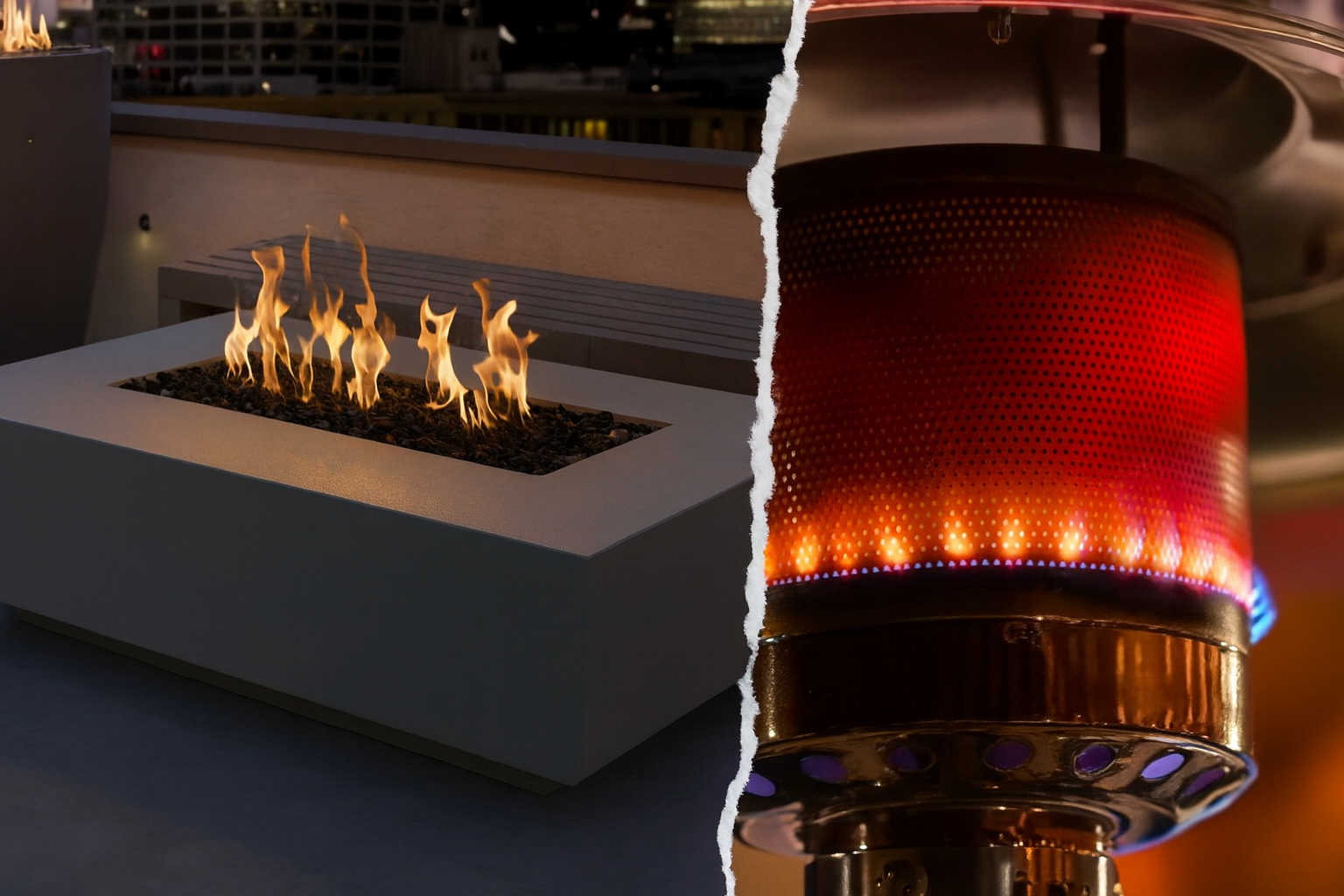
When the temperatures drop, smart homeowners want to keep their outdoor areas warm and cozy. But which outdoor heating solution is right for you?
The most popular options include fire pits and patio heaters – but which is better suited to your outdoor space and your individual needs?
In this guide, we analyze the advantages and disadvantages of both types of heating so that you can make the best decision for your home. Whether for convivial evenings with the family or for cozy garden parties – you’ll find the right solution here.
1 Advantages and disadvantages of fireplaces
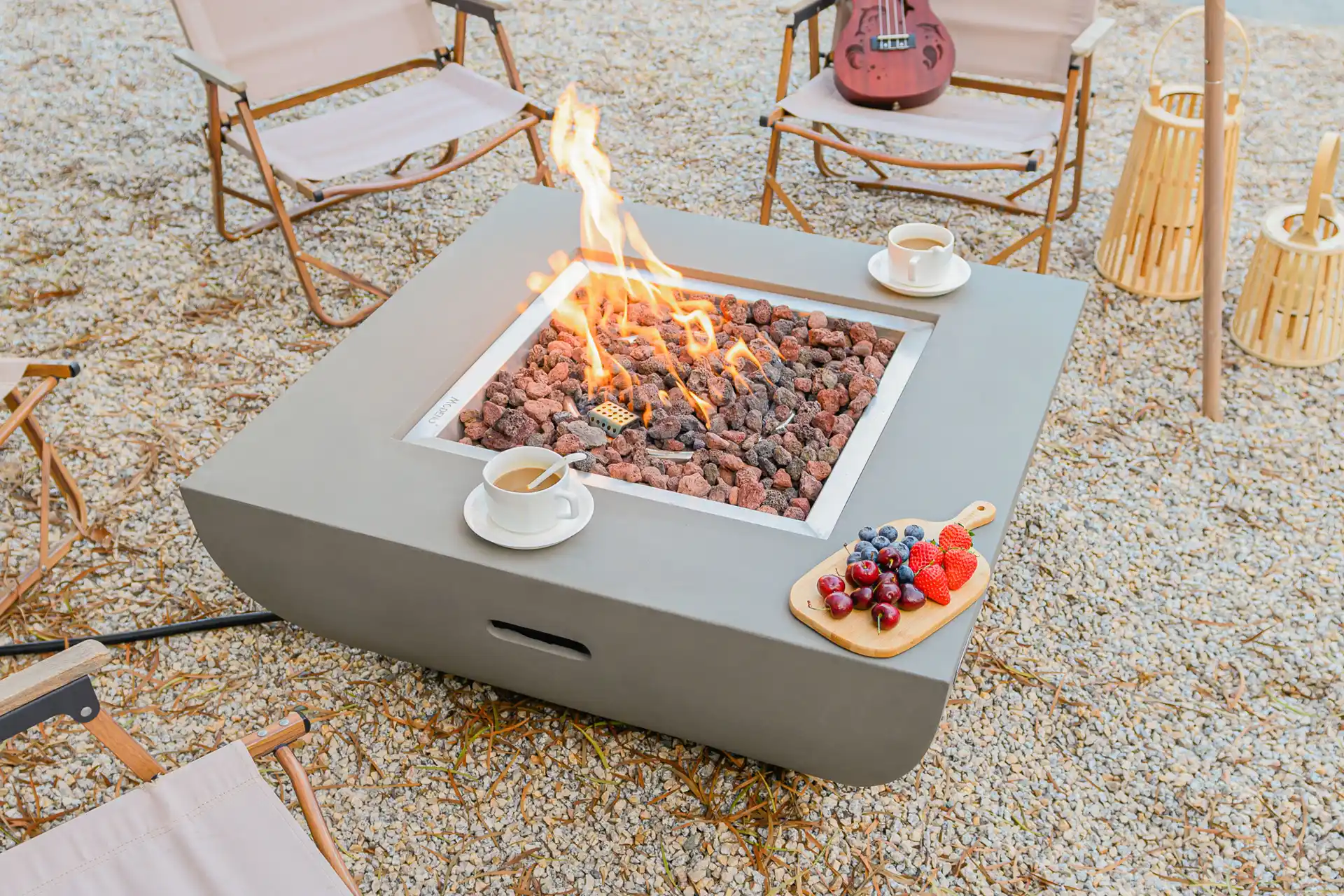
If you are looking for a classic, cozy outdoor heating solution that does not require complex installation or high maintenance costs, a fire pit is the perfect choice. Whether traditional wood flames or modern gas fire pits – both bring warmth and atmosphere to your garden and create the ideal focal point for sociable evenings.
Wood-burning fireplaces offer an authentic campfire feel, while gas or propane models offer convenience, safety and low maintenance. Both options create a warm and inviting atmosphere for spending time outdoors with family and friends.
1.1 Advantages of fireplaces
– Create a central meeting point in the outdoor area.
– Provide a cozy, natural atmosphere.
– Can be operated with wood or gas.
– Some models are also suitable for grilling or heating food.
– Gas models are easy to clean and easy to ignite.
– Improve the overall appearance and energy of your garden.
– Ideal for commercial use – e.g. hotel terraces or restaurant areas.
1.2 Disadvantages of fireplaces
– Improper use can be dangerous.
– Higher maintenance costs compared to other heating solutions.
– Heavier models are usually permanently installed and less mobile.
– Natural gas versions cause higher installation costs.
– Need more space.
– Wood fires produce smoke, sparks and ash.
– A cover is recommended to extend the service life.
2 Advantages and disadvantages of patio heaters

Patio heaters – also known as “umbrella heaters” – are ideal for extending the outdoor season. They are available as electric or gas-powered versions. Electric heaters require no refilling, while gas heaters offer higher heat output (BTU) and greater coverage. Both options provide comfortable warmth all year round.
2.1 Advantages of patio heaters
– Constant heat without smoke, soot or ash.
– Easy to move and flexible to use.
– Available with safety functions such as anti-tip protection.
– Electric models do not require refilling.
– Ideal for commercial use such as outdoor areas of restaurants.
– Cost-effective to operate, easy to use.
2.2 Disadvantages of patio heaters
– Electric models require a power connection (120 V or 240 V).
– Gas heating systems require regular replacement of propane cylinders.
– Operating costs can be higher than for fireplaces.
– Less visually appealing than open flames.
– Heat is concentrated in a small area.
– Susceptible to wind without secure anchoring.
3 Fire pit vs. patio heater – comparison
When comparing fire pits and patio heaters, design, heat output, fuel efficiency, safety and cost should be carefully weighed up. Here is an overview of the most important differences:
3.1 Design and aesthetics
Fire pits have a rustic design and create a cozy atmosphere, but require more seating space. Radiant heaters are usually free-standing or wall-mounted, have a more modern look and fit well into minimalist outdoor concepts.
Conclusion: Fireplaces offer a more traditional ambience, radiant heaters score points for comfort and modern design.
3.2 Heat output and coverage area
Fireplaces offer a higher heat output – usually between 30,000 and 150,000 BTU – while patio heaters usually reach up to 50,000 BTU. Fireplaces heat larger areas, while radiant heaters are ideal for targeted heat in smaller spaces.
Conclusion: Fireplaces provide more heat and cover larger areas.
3.3 Fuel efficiency and operating costs
Fireplaces:
– Natural gas: Higher installation costs, but inexpensive operation (€0.25-€0.75 / h).
– Propane: Simple installation, costs around €1.00-€3.00 / h.
– Wood: Inexpensive and sustainable, around €0.25-€0.75 / h.
Patio heaters:
– Electric: €0.50-€2.50 / h depending on the electricity price.
– Propane: Higher heat output, but higher consumption (€1.50-€3.00 / h).
Conclusion: In the long term, fireplaces are more energy-efficient and cost-effective.
3.4 Safety aspects
Safety is the top priority. Wood fires produce sparks and smoke, while gas models often have automatic switch-off and gas stop functions. Patio heaters are usually equipped with tilt protection and automatic gas shut-off.
Conclusion: Both options should only be used under supervision and in accordance with the safety guidelines.
4 Important selection criteria
4.1 Outdoor area and location
For large gardens or patios, an open fireplace creates an incomparable ambience. If space is limited, one or two radiant heaters offer flexible warmth in a small space.
4.2 Fuel type and availability
Radiant heaters usually use propane, whereas fireplaces use gas or wood. Propane fireplaces are particularly practical for mobile use, as gas cylinders are readily available.
4.3 Heat and efficiency
Fireplaces reach up to 150,000 BTU, radiant heaters usually reach a maximum of 50,000 BTU. Higher BTU values mean more energy consumption – so choose according to requirements and room size.
4.4 Weather resistance and durability
Fireplaces are more robust and designed for outdoor use. Many models are supplied with weatherproof covers. In regions with a changeable climate, weatherproof materials should be preferred.
4.5 Maintenance and care
Fireplaces require regular cleaning and inspection of the gas connections, while radiant heaters only need to be cleaned occasionally. Always follow the manufacturer’s instructions to extend the service life.
5 Price and price-performance ratio

The price plays a central role in the decision between a fireplace and a radiant heater. Here is an overview of the cost factors:
5.1 Acquisition costs
Fireplaces are usually cheaper than radiant heaters, with price differences depending on size, material and functions. Stone and concrete models are more expensive, metal or portable versions are cheaper.
5.2 Fuel costs
Fireplaces are cheaper to run as they can use natural gas or wood. Patio heaters usually require propane cylinders, which have to be replaced regularly – this increases the running costs.
5.3 Maintenance costs
Both systems incur maintenance costs. Fireplaces need to be cleaned and components such as grilles occasionally replaced, while radiant heaters should be checked regularly for leaks and electrical safety.
5.4 Long-term costs
In the long term, radiant heaters are usually more expensive to operate – due to higher energy consumption and maintenance. Gas-powered fireplaces are more durable and economical.
5.5 Conclusion on economic efficiency
Overall, fireplaces offer better value for money in the long term. They are cheaper to maintain, require little maintenance and also create a cozy atmosphere.
6 Frequently asked questions about fire pits and patio heaters
6.1 Which option is more suitable for large outdoor areas?
Fireplaces are more suitable for large terraces or gardens due to their higher heat output.
6.2 Which fuels are used?
Fireplaces can be operated with natural gas, propane or wood, radiant heaters usually with propane or electricity.
6.3 Which option is more cost-effective in the long term?
Fireplaces powered by natural gas are the most economical in the long term – low maintenance, low operating costs.
6.4 Which safety aspects are important?
Always follow the manufacturer’s instructions, keep away from flammable materials and never leave the appliance running unattended.
6.5 Can you cook on a fireplace or a radiant heater?
Wood fires are suitable for grilling or roasting, gas fires only for marshmallows. Radiant heaters are not intended for cooking.
6.6 How do design and aesthetics differ?
Fireplaces are available in many designs and materials that blend harmoniously into any environment. Radiant heaters often have a more technical appearance, but modern models offer elegant surfaces.
6.7 Which option creates the better atmosphere?
Fireplaces with real flames and crackling create an incomparable ambience. Radiant heaters provide pleasant warmth, but less visual impact.
6.8 How do I look after fireplaces and radiant heaters properly?
Read the manufacturer’s instructions carefully. Regular cleaning, checking connections and seals as well as checking the gas pipes are essential for safety.
7 Conclusion
Whether a fire pit or patio heater – the decision depends on your lifestyle and the conditions of your outdoor area. Both options have their strengths and weaknesses.
If you prefer a natural atmosphere and real flames, a fireplace is ideal. If you want comfort, safety and ease of use, a radiant heater is the better choice.
Whether you want to create a cozy atmosphere or entertain guests – with the right heating solution, your outdoor area will become a place of well-being. Discover our selection and find the perfect solution for your needs.